Thursday, 3 January 2013

Mabamba Bay: A marshy paradise for bird species


A serene place to unwind from, Mabamba Bay on Lake Victoria offers you a beautiful view of different bird species.
On the shores of Lake Victoria, is the Mabamba Bay wetland covering about 17,000 hectares of an expanse of miscanthus—a type of grass native to tropical and subtropical region—but more commonly known as papyrus. The open water in form of a canal is used to trail birds and access Busi island that is home to over 40,000 people.
The swamp has a high population of bird species, which include the endangered shoebill. There are also large congregations of migrant birds such as blue swallow and papyrus endemic birds-papyrus gonolek, yellow warbler, jacana, kingfisher, lap wines, herons and eaglets. This is an attraction for the about 200 to 300 visitors who come here every month.
Upon arrival at the site, you are mostly likely to encounter boat operators who will try to attract you to their boats with offers depending on whether you are a passenger crossing to Busi or a tourist coming to watch birds. Crossing to Busi costs Shs2, 000 per person while bird watching is Shs50, 000.
The wetland is designated as a Ramsar site and an important birding area. Ramsar sites are wetlands of international importance designated under the Ramsar Convention. Mabamba Bay is believed to be a major breeding site for the endangered shoebill that is loved by many bird watchers.
The shoe bill
The shoe bill is a large stork-like bird that gets its name from its unique shoe-shaped bill. It is known for its interesting character, especially when in captivity or prostrating before tourists.
Lawrence Simbwa operates a boat at Mabamba Bay. He says the bay was intact until fishermen created paths to go fishing.
“As they went fishing, people realized it was easier to cross to Busi and created a permanent canal leading to the island,” he says.
With this, it was realized that there was tourism potential with the opening of ways through the swamp and develop it into an important birding site. This led to Mabamba bay being promoted as such. Irene Namubiru, a guide and an office attendant at the Mabamba Wetland Eco-Tourism Association, says the association was formed to tap into this tourism potential.
“We now handle visitors, guide and aid them to track birds and protect the wetland against encroachers,” she says. She adds that the challenge is people who fear using the boats to trail and watch the birds. Thus, a need arose to develop how to cater for such visitors over the main land. “We recently got a minibus to carry about 30 visitors but only three managed to go birding in the wetland as others stayed at the bay looking on,” she added.
She thinks people can help them develop the nearby Banga cultural tourism site that is a huge rock with shelter inside to cater for tourists fearing the lake. Other than the association, community members have also formed Mabamba Bird Guides and Conservation Association, a site support group to promote conservation through community involvement.
The group is involved in a wide range of conservation activities, including tourism, education, awareness and habitat protection. It is voluntarily run by its members and is registered with the Mpigi District Local Government.
There are also projects by civil society organizations like Nature Uganda to strategically target the conservation of the globally threatened species, especially the Shoe bill, which will eventually benefit all species within this habitat.
The project helps protect the birds’ breeding site and mitigate major threats such as shoebill trafficking. However, the local communities are the drivers of the initiatives, enhancing their livelihood through promotion of eco-tourism. Ugandans who take holidays abroad are leaving behind a better deal in their own motherland.

Thursday, 13 December 2012

Uganda for primates safaris-Mawa, Ngamba’s mischievous chimpanzee sanctuary


Ngamba Island Chimpanzee caretaker Stanley Nyandu assisting Mawa cut a cake during Ngamba Island chimpanzee sanctuary’s 10th anniversary celebrations on October 13. Mawa stands out of the crowd of chimps at Ngamba Island sanctuary. His escapades have forced the environment around him to change and not the other way round.

There is a lot that goes on in the thickets on Ngamba Island. Though it is frequently presented as a serene sanctuary that would make a haven even for human beings, the activities of its inhabitants are perhaps an even more revealing aspect of what is usually not said when stories about the wonders of Uganda tours.
Ngamba is home to 48 chimpanzees that are there mostly because they have been rescued from one danger or another. The apes are given the closest to heaven that they could possibly ever dream of. It is also the home of Mawa, the chimpanzee. Ngamba Island is situated about 23km from Entebbe Town.
Mawa stands out from the rest of the chimps on the island. Of the known animals there, this one chimpanzee has forced the environment around him to change and not the other way round. Usually, the surroundings around an animal will press in on the beast and behavioral change will occur or else the animal will be risking extinction.
Perhaps, because there are a few chimpanzees on Ngamba, anything peculiar that one of them does will be scrutinized and dissected. There are not very many chimpanzees in the world. An estimate by the International Union for Conservation of Nature in 2008 put the number of the apes at about 170,000.
Mawa spends his days in a large cage at the island run by the Chimpanzee Sanctuary and Wildlife Trust. He looks forlorn in his meshy prison though there are recreational facilities in the cage; the hammocks and rubber tyres, where he shows off his gymnastics.
He brought this on himself, according to Lilly Ajarova, the director of the sanctuary. “We had to cage him because of his continuous escapes from the forest and enclosures as a result of being fought by higher ranking chimps,” Ms Ajarova explains. “He was the alpha male of the juvenile group and when the group was integrated into the adult group, Mawa thought he was losing his power.”
Accordingly, the chimp decided to fight the system, as Ms Ajarova explains. Mawa was not ready to bow down to the new Alpha Male, the leader of the whole community. “This sparked off regular fights between him and other higher ranking chimps that wanted to be respected. This forced him to escape regularly as he could not stand the pressure.”
In the animal world, hierarchy is respected. Older chimps are usually bigger and more experienced. Mawa was a rookie looking to be respected without having gone through the school of hard knocks. That was not going to be accepted by the others.
But this fix also brought out in him the skills he is also known for. Whenever the fights started, he would try to jump the fence or he would just scale it. It is wire mesh structure with pulse electricity. According to Phillip Ssekulya, a guide, this means there is just enough electrical charge to stun the animals if they touch the fence but not strong enough to kill.
Apparently, Mawa cottoned to the idea that this was not a danger. While the chimpanzees mostly keep to the trees for the larger part of the day and only come to the fence when it is time for feeding, Mawa would run to the fence and scale it, pulse electricity and all.
Ssekulya speaks of the somersaults the chimp is known for. He is known for having taken on four or five bigger chimps and running rings around them with his gymnastics. “The apes would be greatly agitated because try as they might have wanted to, they just could not pin him down,” he recalls.
Mawa originated from the Democratic republic of Congo. Ajarova explains that the chimp was confiscated in Arua District where his captor was holding onto his dead mother and the baby chimp, about 16 years ago.
Many of the chimpanzees on the island were acquired in similar circumstances. Many communities in eastern Africa still prize game meat and even with the fact that chimpanzees are an endangered species, it is clear that a lot more sensitization about the benefits of conservation. Meanwhile, organizations like CSWCT continue looking for animals in danger and take them to Ngamba Island.

Monday, 10 December 2012

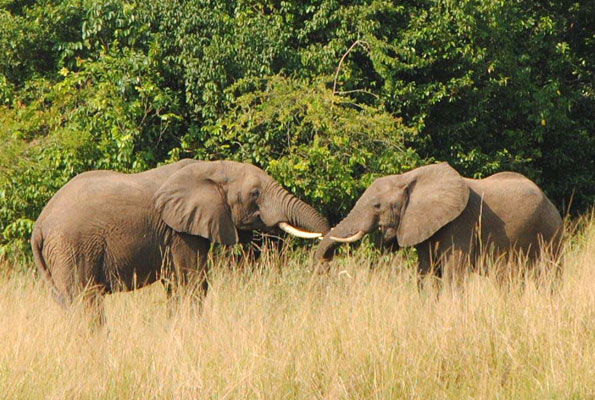
Uganda for sustainable tours in corridors to control human-wildlife conflicts “Elephants”


Elephants at Murchison Falls National Park, Elephants from South Sudan have destroyed crops in Adjumani. Wildlife officials in Uganda say the animals could have escaped to Uganda following a dry spell in the neighboring country.
The Uganda Wildlife Authority officials are battling a herd of elephants that crossed from South Sudan in Nimule National Park to villages of Pagirinya and Mukoyoro in Adjumani District. The elephants have from last week been razing acres of crops in the country. South Sudan is usually dry towards the end of the year.
“Elephants make long treks from Sudan to Uganda tours  and back in search of pasture every year and these places are known wildlife corridors but the increasing population has prompted people to settle in the corridors that has caused a serious human-wildlife conflict,” Ms Lillian Nsubuga, the Uganda Wildlife Authority public relations manager, said last week.
Response
She said from the time the elephants crossed last week; they dispatched a team to drive them from people’s gardens. “Efforts are under way to drive them towards River Unyama where there no communities that are not an easy thing because elephants cannot be chased like cows. Rangers either fire in air or use chili to disperse the elephants hiding in bushy places that cannot be achieved easily,” Ms Nsubuga added.
Mr. Tom Okello Obong, the Murchison Falls Conservation Area manager, said many parts of northern Uganda are remote and filled with bushes that make it easy for elephants to hide in the bushes yet gardens are far apart and surrounded by big bushes. She said people should cultivate near areas where elephants fear going and respect wildlife corridors.

Friday, 7 December 2012

Uganda Tours for Mountain Rwenzori Trekking


The Rwenzori Mountains National Park among the UNESCO’s World Heritage Site, It has four trails and two nature walks, with the creation of the Muhoma trail, which is targeted for tourists interested in shorter trails.
While the Rwenzori Mountains are a sight to behold, not many tour operators put them on their itinerary because it usually takes more than a week to enjoy a trail walk on any of the slopes. However, with the new Muhoma trail, tourists can enjoy a bit of the mountains in one to three days only.
It is true at this trail Uganda is discovered, this is a place that travelers to Uganda should not miss, “It is good the communities are benefiting from the tourism industry as they are taught to conserve the environment and out of the revenue from this trail and the park at large supports their local projects like agriculture where they generate a living.”
Getting to the trail
Sounds of River Nyamwamba greet your ears at this new tourist attraction that opened in August. Cater was excited after she trekked through the new trail. The place can be reached about 10kms on Kasese-Fort Portal road, after which one branches left at Kasanyarazi and ascends 12kms on a dirt road, which is still under rehabilitation.
Muhoma Nature Trail was built by Uganda Wildlife Authority (UWA) using funds from USAID’s Sustainable Tourism in the Albertine Rift (Star) project and is the latest product in the national park. The trail, that lets visitors enjoy one-to-three-day walks, traverses the lower slopes of the mountains up to Lake Muhoma, where the trail joins the existing Central Circuit trail.
About the trail
This is the fourth trail and the second nature walk in the national park tucked in western Uganda. The other trails include the Central Circuit, run by Rwenzori Mountaineering Services (RMS), Kilembe, run by Rwenzori Trekking Services (RTS), and Kazingo Nature Walk trail, which has been the only trail open to all tour operators since the other trails are privately run. Uganda Wildlife Authority manages the new trail and is open to all tour operators.
“The concessional trails are limited to contracted companies, but the new trail is open to anybody. You don’t need to go through a third party to use it,” said Fredrick Kizza, the park’s senior warden. “This shorter trail is an opportunity for those clients with limited time. Because of the long time needed to climb the mountain, most tourist operators leave out Rwenzori”.
The Rwenzori are a world-class hiking and mountaineering destination, which were recently voted among the world’s best hiking sites. The world heritage site is well known for its extraordinary flora and different vegetation zones. However, the mountain continues to struggle to attract tourists.
According to Kizza, in 2000, the park attracted a paltry 600 visitors. This number has since grown to 2,300, according to last year’s statistics. Kizza says the park has already attracted 2,285 visitors since January, a figure that is expected to shoot to 3,000 by the end of the year.
Attractions beyond the trail
With better facilities, the numbers are bound to go even higher. Geolodges have opened up their fourth lodge, the Equator Snow Lodge in Rwenzori Mountains National Park. “We hope that the addition of these new tourism facilities and the trail will help to boost tourism to the mountains, increasing revenues for the people of the region as well as supporting Uganda Wildlife Authority and Eco trust in their ongoing conservation efforts”.
USAID-Star with support from US Forest Service, and in partnership with Eco trust, Uganda Wildlife Authority and Geolodges, also boosted the lodge with the construction of an information centre at a cost of $100,000 (approximately Shs260m).
The centre is a multi-function facility next to the park, providing information and services for visitors to be able to learn more about the park and the mountain, its people and their culture.

Monday, 26 November 2012

Uganda for Birds-Uganda tours,Uganda birding tours

Uganda birders and Tourism Minister Maria Mutagamba enjoys a view of birds at Kasenge Forest in Mbalala, Mukono District at the weekend. The news of the country being a key bird watching destination will boost the tourism sector.
According to Birdlife International and Nature Uganda, the country accounts for 50 per cent of Africa’s bird species.
Uganda has been declared a preferred bird watching destination 2013/14 a development expected to promote birding and uphold the country as a major tourist destination. Among the Uganda birding tours can be done at Mabira Eco tours/safaris, Budongo forest where you can bird at Kaniyo-pabidi site, Bwindi impenetrable national park, Ngamba islands chimpanzee tours/safaris, Mabamba bay birding site among others
The declaration by the government was made after Birdlife International, a global programme on conservation and protection of birds and their habitats, and Nature Uganda announced that there were 34 important bird watching areas in Uganda, with diverse bird species. It only in Uganda where you can search the Shoe bills at Mabamba bay, Ssezibwa falls, Ziwa rhino sanctuary, Bigodi wetland, Entebbe gardens hotel and the shores of River Nile at Murchison falls national park
Uganda a preferred bird watching destination as we begin our journey through the next 50 years as we mark the country’s independence jubilee celebrations,” the Minister for Tourism, Ms Maria Mutagamba, said during the launch of the birding campaign that attracted various birders and guides at Kasenge Forest Resort Beach in Mukono District at the weekend. Birding can be also enjoyed at Mabira reserve forest where you can do Eco tours and safaris, Bike cycling, nature and forest camping, community walk and enjoy local snacks like roasted chicken at Najjembe local market with the Mabira forest reserve an Eco tourism destination.
Ms Mutagamba said they had been priding in the recent accolades by Lonely Planet, which voted Uganda as the best tourism destination for 2012 and Africa Bird Club, which voted Bwindi Impenetrable National Park, Africa’s number one birding site.
The minister said the accolades provide an important avenue for showcasing Uganda’s rich bird diversity, accounting for 10 per cent of the world’s total bird species and 50 per cent of Africa’s bird species population.
Below are some of bird species
Non-passerines: Ostriches . Grebes. Shearwaters and Petrels . Pelicans . Cormorants . Darters . Bitterns, Herons and Egrets . Hammer kop . Storks . Shoebill . Ibises and Spoonbills . Flamingos . Ducks, Geese and Swans . Osprey . Hawks, Kites and Eagles . Secretary-bird . Caracaras and Falcons . Pheasants and Partridges . Guinea fowl . Buttonquails . Cranes . Rails, Crakes, Gallinules, and Coots . Sun grebe and Fin foots . Bustards . Jacanas . Painted snipe . Oystercatchers . Avocets and Stilts . Thick-knees . Pratincoles and Coursers . Plovers and Lapwings . Sandpipers and allies . Gulls . Terns . Skimmers . Sand grouse . Pigeons and Doves . Parrots . Turacos . Cuckoos . Barn owls . Typical owls . Nightjars . Swifts . Mouse birds . Trogons and Quetzals . Kingfishers . Bee-eaters . Typical Rollers . Hoopoes . Wood hoopoes . Hornbills . Barbets . Honey guides . Woodpeckers and allies .
Passerines: Broadbills . Pitas . Larks . Swallows and Martins . Wagtails and Pipits . Cuckoo-shrikes . Bulbuls . Thrushes and allies . Cisticolas and allies . Old World warblers . Old World flycatchers . Wattle-eyes . Monarch flycatchers . Babblers . Tits . Tree creepers . Penduline tits . Sunbirds and Spider hunters . White-eyes . Old World Orioles . Shrikes . Bush shrikes and allies . Helmet shrikes . Drongos . Crows, Jays, Ravens and Magpies . Starlings . Weavers and allies . Waxbills and allies . Indigo birds . Weavers and allies . Buntings, Sparrows, Seedeaters and allies . Siskins, Crossbills and allies . Sparrows .